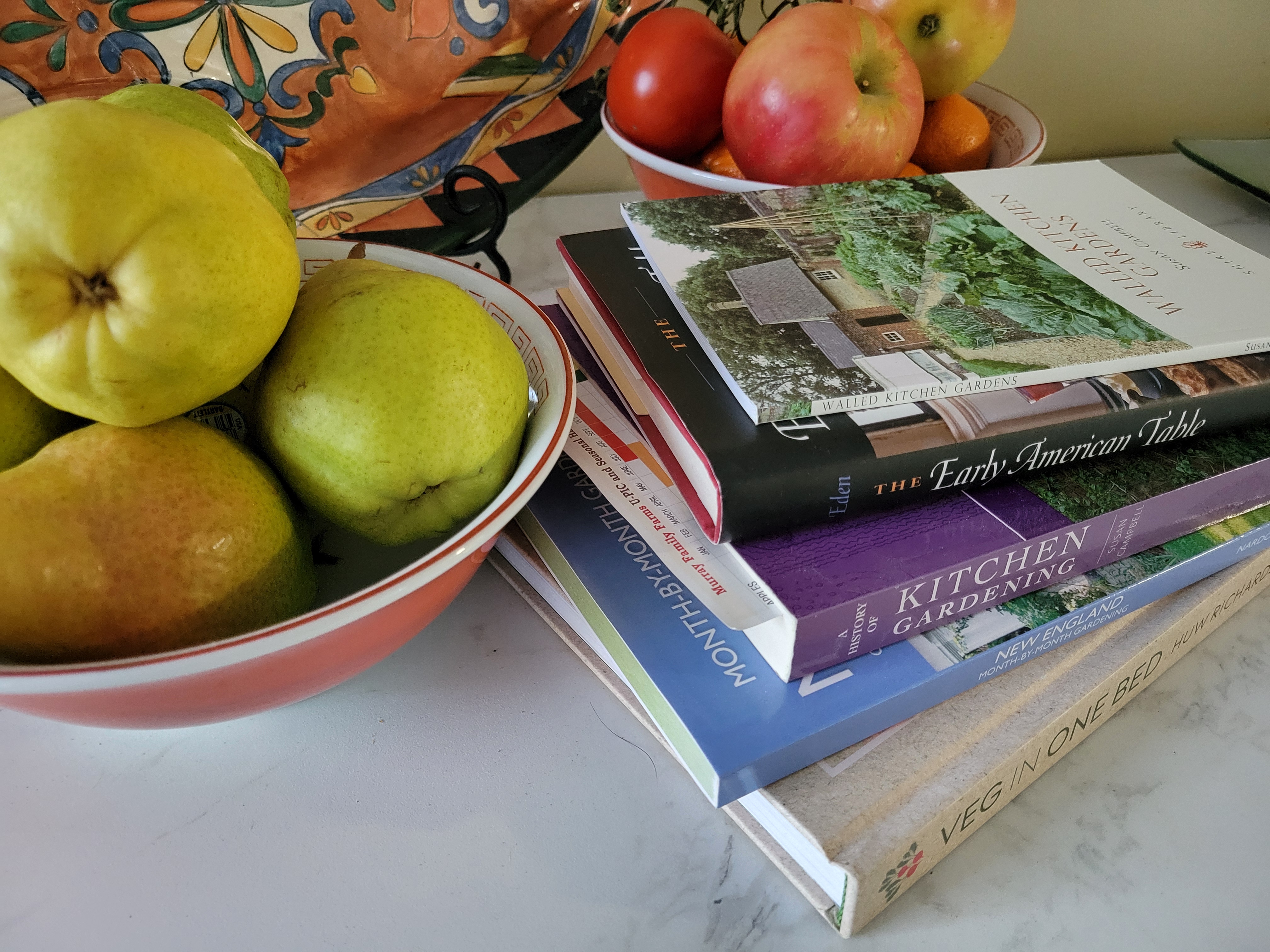

One of my favorite parts of touring historic homes is visiting the kitchen gardens.
It was incredibly common in homes built before the turn of the 20th century to be accompanied by a working kitchen garden. Not necessarily the primary means of a residing family’s food supply, the kitchen garden acted as a supplement to the foods that were obtained from friends and family as well as what they may have grown in the larger fields.
Often filled with herbs, lettuces, small crops like carrots, potatoes, or onions, and even flowers, the kitchen garden of yesteryear much resembles the small raised bed gardens we grow today.
That said, I personally feel that the kitchen gardens in these historic homes hold so much character and charm. Please take a look at this wonderful “cook’s garden” from the Deerfield, Massachusetts Historic Village.


Or how about this simple, small garden at the Stone House in Belchertown, Massachusetts?

Kitchen gardens could be as big or as small as a family needed!
Alongside visiting the gardens of historic homes, my favorite souvenir to pick-up at the gift shop is a cookbook–preferably one that includes recipes from the overall time period or a collection of recipes that were a favorite of the house itself. Here is a small sampling of cookbooks that I recently obtained from The Emily Dickinson Homestead and The Deerfield Historic Village, as well as one that my grandmother gave me from the Norman Rockwell Museum in Stockbridge, Massachusetts.


I like these particular cookbooks because they showcase the range that you can find at a historic home.
The Emily Dickinson cookbook is a showcase of the poet as a cook herself. The recipes contained are those that Emily would have likely made, and with each there is a tidbit of contextual information about both the recipe and how it related back to the poet. From her gingerbread to wine jelly, alongside the recipes is a brief snapshot of Emily’s culinary life. This cookbook is a wonderful treat and allows us to learn a whole new (domestic) side to the poet.
My Norman Rockwell cookbook is a more standard cookbook, but I like it because it contains recipes submitted to “The Saturday Evening Post”–the publication Norman Rockwell contributed several iconic covers to. In the way that Normal Rockwell celebrated people from all walks of life, this cookbook does the same. From salads to desserts, we are introduced to so many interesting variations and itterations of comforting classics.
I won’t go into detail about my cookbook from Deerfield as I discuss it further below alongside my recreation of Mollie Saunder’s Upper Shelf Gingerbread found within that book.
The next time you visit a historic home, check the giftshop for a cookbook. Even if you aren’t culinarily inclined, at the very least, I know that you’ll learn something fun and intersting about the basic art of cooking!

Mollie Saunder’s Upper Shelf Ginerbread
This recipe is from The Pocumtuc Housewife: A Guide to Domestic Cookery As It is Practiced In The Connecticut Valley (1805).
It was a practical guide originally put together by The Deerfield Parish Guild of the First Church of Deerfield (Deerfield, Massachusetts) and contains a number of recipes, remedies, and basic notes and how-to’s on domestic living in the 1800’s. Within this mere 60 page pamphlet you learn “what to eat,” how to cook said food, and in conclusion the rules for maintaining optimal health.
This guide is a wonderful glimpse into the life of the village folk of rural Deerfield in the late 1700’s/early 1800’s. I am particularly fond of the tagline for this book: “The fruit of experience freshly gathered from Elderly Lips, and preserved in print.” I think having this guide in print since 1805 is a strong testament to the guidance it contains, and beyond the novelty of recreating the recipes and remedies within, has allowed me to be more aware of the rich history of New England and the challenges initial settlers faced in the wild New World.
While the recipe instructions are sparse (which is pretty common in older cookbooks), with a little creative thinking the resulting food is just as good as any you could make today.
My latest attempted recipe from this book is Mollie Saunder’s Upper Shelf Gingerbread. With fall here, I was craving a sweet treat and I’m particularly fond of the bite of a good gingerbread cookie. And so, one brisk autumn morning, I whipped up Mollie’s own batch. I was promised a delicacy from the best bakeshop in Salem and they do not disappoint.
Below I have included a photo of the original recipe, but if you are a bit nervous to go off of the limited guidance of dear Mollie, I’ve added my own instructions along with measurements adjusted down to a quarter of the orignal recipe so that you aren’t absolutely swimming in gingerbread!

Ingredients
- Flour – 3 3/4 cups (470 grams)
- Unsalted Butter – 8 tablespoons
- Molasses – 1 cup (340 grams)
- Baking Soda – 1/4 tablespoon (disolved with 1 tablespoon warm water)
- Ginger – 2 teaspoons
Directions
- In a medium pot, melt the butter and molasses together. As soon as the butter is completely melted, you can take the mixture off the heat, but don’t let it sit too long as it will harden as it cools down.
- While the butter and molasses mixture is cooking, combine your flour, ginger, and baking soda mixture into a bowl.
- As soon as your butter/molasses mixture is all melted together, add it to your flour mixture and stir until completely combined. Becuase the molasses/butter is warm, this is going to be a fairly soft dough. As the mixture cools it will get more firm, so just mix everything together until is is all combined into a single loose ball.
- Wrap the ball in cellophane and put in the refridgerator for 2 hours until completely cool.
- Shortly before your dough is ready to come out, preheat your oven to 350°.
- Once cooled, roll out the now firm dough into a 1/4 inch thick slab and cut out your favorite shapes.
- Place your cookies on parchment lined sheets. Give them about 1/2 and inch of space in between each cookie. They won’t rise up much, but in order to get that classic crispy edge, the space helps.
- Bake your cookies for 10-12 minutes. 10 minutes if you want softer cookies and 12 for crispier.
- Once done, remove from the oven and let them sit on the sheets for 8-10 minutes. This will help them set. After, move them to wire-racks to cool completely.
- Enjoy!

Leave a Reply